From Assad to al-Sharaa: Syria’s New Rulers and the Unfinished Promise of Liberation
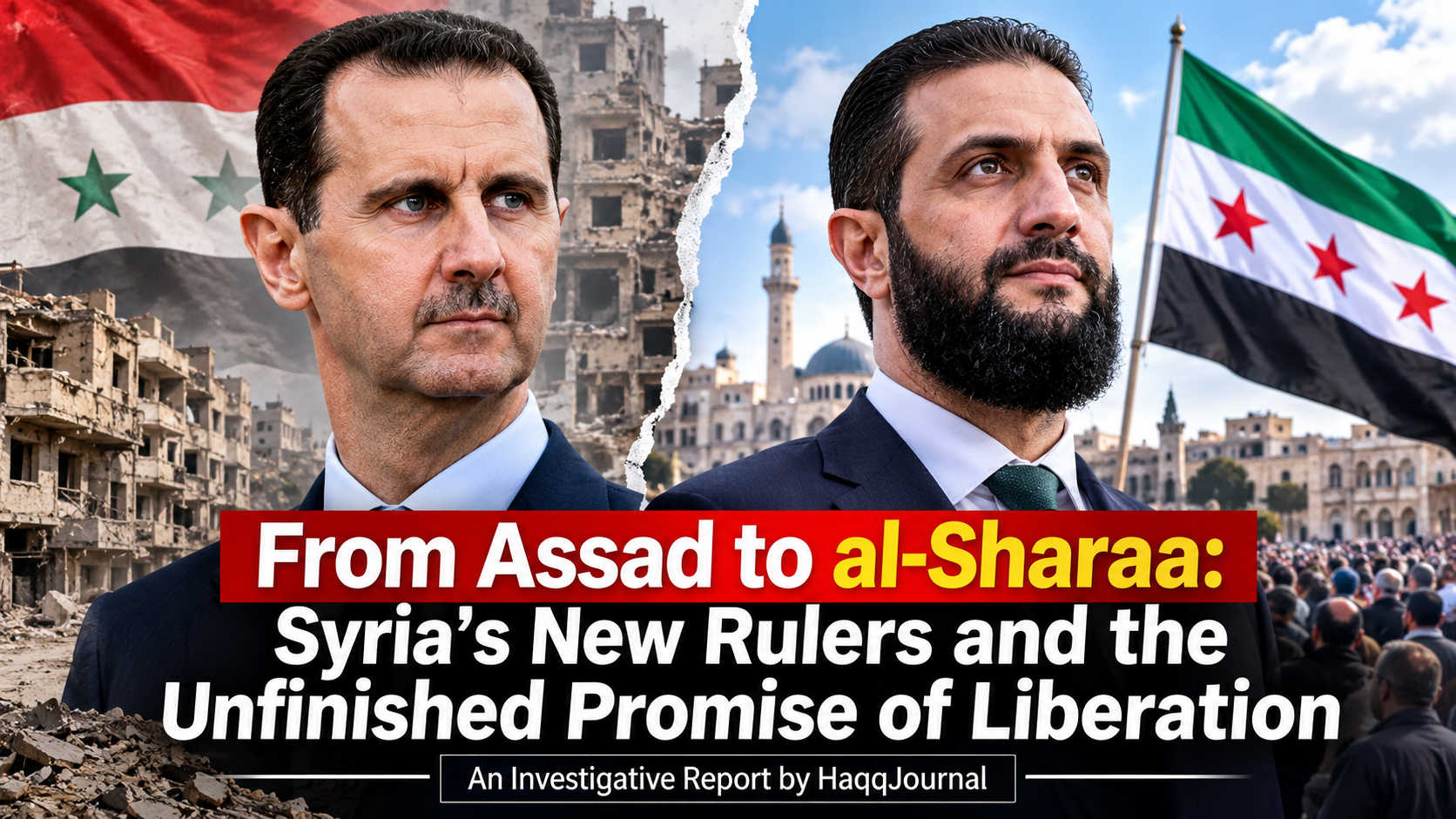
FROM ASSAD TO AL-SHARAA: SYRIA’S NEW RULERS AND THE UNFINISHED PROMISE OF LIBERATION
By HaqqJournal | Investigative Analysis
The Fall of a Regime, the Rise of a New Order
On 8 December 2024, the streets of Damascus witnessed a moment that many Syrians had spent decades hoping to see. Bashar al-Assad, whose family had governed Syria for more than half a century, fled the country as opposition forces entered the capital.
For millions of Syrians, the collapse of the Assad government represented the possibility of a new beginning. After years of war, displacement, political repression and economic devastation, the prospect of rebuilding a country free from authoritarian rule appeared within reach.
But the political transformation that followed was not a conventional democratic revolution.
The offensive that brought down Assad was led by Hay’at Tahrir al-Sham (HTS), an Islamist organisation formerly affiliated with al-Qaeda. Its leader, Ahmed al-Sharaa, emerged from the battlefield as Syria’s new political authority.
On 29 January 2025, al-Sharaa was declared president for the transitional period, consolidating his position less than two months after the former government collapsed. The announcement followed the dissolution of the previous political institutions and the suspension of the 2012 constitution. Reuters
The transition was historic. Yet it introduced a question that now sits at the centre of Syria’s future:
Did the fall of Assad mark the beginning of a democratic transformation, or the transfer of power from one centralised leadership to another?
The New President and the Concentration of Power
The emergence of al-Sharaa as president has fundamentally altered Syria’s political structure.
The new leadership has presented itself as a transitional authority tasked with restoring security, rebuilding institutions and preparing the country for a permanent constitutional order.
In March 2025, the transitional authorities adopted a constitutional declaration establishing a five-year transition. The document recognised a number of individual rights and outlined the framework for future governance.
However, the declaration also concentrated significant authority in the presidency.
According to Human Rights Watch, the president was granted extensive powers over the legislative and judicial branches, including the authority to appoint one-third of the People’s Assembly and all members of the Higher Constitutional Court.
The organisation warned that the framework lacked sufficient checks and balances to safeguard judicial independence and meaningful political participation. Human Rights Watch
The government has argued that extraordinary powers are necessary during a fragile transition following years of conflict.
But this justification raises a fundamental issue.
If the purpose of the transition is to dismantle authoritarian governance, what safeguards prevent the temporary concentration of power from becoming permanent?
The establishment of new institutions is not, by itself, evidence of democratic transformation. Their independence, accountability and ability to challenge executive authority will ultimately determine whether Syria is moving towards a genuinely different political system.
The Question of Political Legitimacy
One of the most significant challenges facing the transitional government is the absence of a direct national electoral mandate.
Al-Sharaa’s appointment followed a gathering of armed groups rather than a nationwide election.
In October 2025, Syria held its first parliamentary elections under the new authorities. However, the process was indirect, with members selected through local electoral bodies rather than through a direct popular vote.
Human Rights Watch reported that the system did not provide Syrians with adequate guarantees of participation in political affairs.
The transitional parliament began meeting in June 2026, with its role including participation in the drafting of a permanent constitution. Yet representation remained disputed, particularly among Kurdish and Druze communities.
The central issue is not simply whether Syria has a parliament. It is whether the country’s political institutions genuinely represent the diversity of its population.
A transition that excludes significant sections of society risks reproducing the political grievances that contributed to decades of instability.
Minority Protection: A Test of the New Government
Syria’s population includes Sunni Arabs, Alawites, Christians, Druze, Kurds and other communities whose political and social experiences have been shaped by decades of conflict.
The fall of Assad created expectations that the new leadership would establish a political order capable of protecting all Syrians, regardless of religious identity or political affiliation.
But violence during the transition has raised serious concerns.
In March 2025, deadly clashes between government forces and armed groups in coastal Syria were followed by widespread killings of civilians, particularly from the Alawite community.
Human Rights Watch documented summary executions, destruction of property and abuses by government forces and affiliated armed groups.
In July 2025, violence in the predominantly Druze governorate of Sweida resulted in further civilian deaths, displacement and reports of serious abuses.
These incidents have raised questions about the ability of the transitional authorities to control armed groups operating under or alongside state institutions.
The government has announced investigations and promised accountability. However, human rights organisations have called for greater transparency regarding the involvement of senior officials and military commanders.
The question facing Syria is whether minority protection will be treated as a constitutional responsibility or as a political promise.
National unity cannot be achieved through declarations alone. It requires the protection of civilians, independent investigations and equal access to justice.
Source: Human Rights Watch, World Report 2026
Transitional Justice: Who Will Be Held Accountable?
For millions of Syrian families, the fall of Assad did not end the search for justice.
Thousands of people remain missing following years of detention, disappearance and violence. Families continue to seek information about relatives who vanished into the former government's detention system.
In May 2025, the transitional authorities established two national bodies: the National Commission for Transitional Justice and the National Commission for Missing Persons.
Their mandates include addressing abuses under the former government, documenting disappearances and supporting families seeking answers.
These initiatives represent an important step towards confronting Syria’s past.
However, a major concern remains regarding the scope of accountability.
Human Rights Watch has criticised the transitional justice framework for focusing on violations committed by the former Assad government while excluding abuses committed by other parties.
This creates a difficult question for the new authorities:
Can justice be considered impartial if it investigates crimes committed by former rulers but fails to adequately investigate violations involving those who now hold power?
A credible transitional justice process must provide truth, accountability and reparations to victims regardless of their political or religious background.
It must also ensure that investigations are conducted independently and that those responsible for serious violations are held accountable through fair legal proceedings.
Without these safeguards, transitional justice risks becoming an instrument of political revenge rather than a foundation for national reconciliation.
The Kurdish Question and the Future of National Unity
The future of Syria’s Kurdish population remains another important challenge.
For years, Kurdish-led forces maintained autonomous institutions in northeastern Syria, operating outside the authority of the Assad government.
Following Assad’s fall, the transitional authorities sought to bring these institutions and armed forces under the control of the central state.
In March 2025, the Syrian Democratic Forces signed an agreement with the transitional government outlining the integration of northeastern institutions into the Syrian state.
However, implementation faced significant obstacles.
The dispute concerns more than military arrangements. It involves political representation, local administration, security guarantees and the future of Kurdish cultural and political rights.
By 2026, negotiations continued as the government sought to extend its authority and integrate Kurdish-led structures into national institutions.
The challenge is finding a political arrangement that preserves Syria’s territorial integrity while addressing the legitimate concerns of communities that fear renewed centralised control.
A lasting settlement will require negotiation, constitutional guarantees and meaningful participation by Kurdish representatives.
The alternative is the risk of renewed conflict in a country that has already endured more than a decade of war.
International Recognition and the Geopolitical Interests in Syria
The transition has also transformed Syria’s relationship with international powers.
Under Assad, Syria faced extensive sanctions and diplomatic isolation. Following his removal, the new authorities began pursuing international recognition, economic reconstruction and the reopening of diplomatic and financial channels.
In November 2025, the United States removed al-Sharaa and Interior Minister Anas Khattab from a UN sanctions list associated with Islamic State and al-Qaeda through Security Council Resolution 2799.
The decision reflected a significant shift in the international diplomatic environment.
However, international recognition should not be confused with domestic political legitimacy.
Foreign governments have their own strategic interests in Syria, including counterterrorism, regional security, migration, reconstruction and competition for influence.
The transitional government must therefore navigate a complex international environment while attempting to establish a stable domestic political order.
For Syrians, the central question is whether international engagement will support institutions that protect citizens or primarily strengthen the position of the new leadership.
Reconstruction and the Economic Reality of Change
Political transformation has not automatically resolved Syria’s economic crisis.
Years of conflict destroyed infrastructure, displaced millions and weakened public services. Electricity shortages, damaged housing, unemployment and humanitarian needs continue to affect large sections of the population.
According to Human Rights Watch, more than 90 percent of Syrians lived below the poverty line during 2025, while millions required humanitarian assistance.
The removal of sanctions and renewed international engagement may create opportunities for reconstruction.
But rebuilding Syria will require more than foreign investment.
It will depend on transparent institutions, protection of property rights, functioning public services and the ability of ordinary Syrians to participate in economic recovery.
The distribution of reconstruction resources will be particularly important.
If economic opportunities become concentrated among politically connected groups, the transition risks creating new forms of inequality and public resentment.
For Syrians who have endured years of displacement and poverty, the measure of political change will ultimately be visible in their daily lives.
Can families return safely to their homes?
Can workers find employment?
Can businesses operate without corruption and arbitrary interference?
Can citizens access electricity, healthcare and education?
These are the questions that will determine whether the transition produces meaningful change.
The Unfinished Promise of Liberation
The fall of Bashar al-Assad was a historic turning point in Syrian history.
It ended a political dynasty that had ruled for more than five decades and created an opportunity to establish a new political order.
But the transition has also revealed the difficulties of transforming a country shaped by authoritarian rule, armed conflict and competing political interests.
The concentration of presidential power, concerns over minority protection, unresolved disappearances and questions surrounding accountability demonstrate that the challenges facing Syria extend far beyond the removal of its former ruler.
The new leadership has an opportunity to establish a political system based on accountability, inclusion and the rule of law.
Whether that opportunity is realised will depend on decisions that remain to be made.
The central question facing Syria is no longer simply who replaced Bashar al-Assad.
It is whether the country’s new rulers will establish a system in which no leader can exercise unchecked power again.
For millions of Syrians, the promise of liberation remains inseparable from the demand for justice, dignity and a meaningful voice in their country’s future.
HaqqJournal will continue examining Syria’s political transition, including the distribution of power, the treatment of minorities, transitional justice and the economic interests shaping the country’s reconstruction.